

Fangirls aren’t the ditzy, delusional, jobless 12-year-olds society’s tried to paint them as for decades. On intelligence, community infrastructure, education, & global fandom as a real social system.
I don’t think I need to explain the insistent misogyny-fueled disrespect fangirls have faced to anyone who hasn’t been living under a rock for the last century.
Being a Gen Z woman who’s been a part of fandom culture since I was at least eight years old, and an established freelance writer and up-and-coming fan engagement strategist who happens to be forging a path for myself in the music industry, this is a topic that’s quite close to my heart, so I decided to write about it.
Because fangirls are constantly made out to be hysterical, embarrassing little girls whose interests begin and end with screaming over attractive men, when in reality, they are some of the most committed, inventive, resourceful, and culturally influential people on the internet.
They build communities, organize campaigns, create entire systems, translate content across languages, raise astonishing amounts of money, sustain artists’ careers, and turn individual enthusiasm into collective action.
And yet, no matter how much labor, intelligence, skill, or impact they demonstrate, their devotion is still routinely treated as something silly, shameful, or inherently lesser simply because it is associated with girls and women.
Well, if you’ve ever failed to see the value in fangirls, maybe this will change your mind.
I’ve been an Army since 2020, and in my opinion, the 2020 to 2022 era was the closest a fandom has ever come to creating its own society.
You may think I’m joking or exaggerating, but I am quite literally not.
Table of Contents:
- I – The Bora Society
- II – Fanboys Are Part of the Fandom, But Here’s Why I’m Focused on the Fangirls
- III – Conclusion
- Unofficial IV – A Fangirl’s Self Promotion
- Sources
I – The Bora Society
I’ll never forget the 2020 Black Lives Matter mobilization. BTS and Big Hit were reported to have donated $1 million to Black Lives Matter during the height of the George Floyd protests; ARMY then launched #MatchAMillion and exceeded the target within roughly 24 hours.
One In An ARMY – a volunteer-powered nonprofit “driven by shared interest in global superstars, BTS, and the idea of using our collective power for global good” which “seeks out nonprofit organizations worldwide and harnesses the power of ARMY into giving micro-donations over a one-month period with the motto ‘I am ONE in an ARMY,’ which plays with the idea that many people giving small amounts can create a substantial impact when working together.” – had already routed about $50,000 in the first four and a half days prior to the public match challenge accelerating donations.
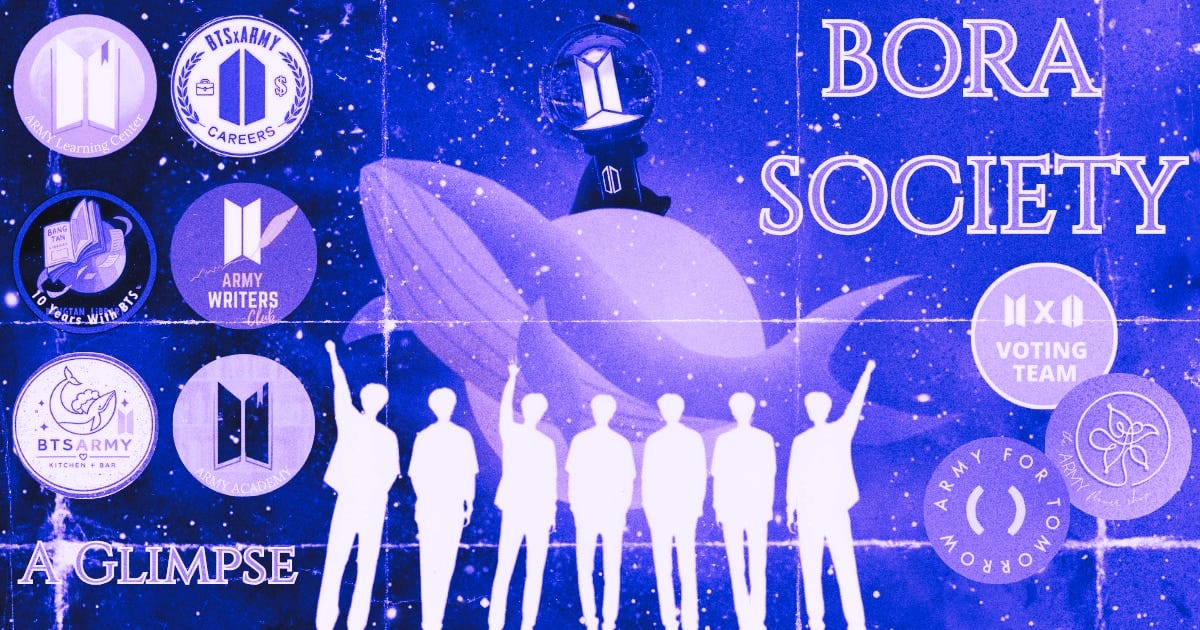
From 2020 to 2022, there were what seemed to be hundreds of new service, charity, or community-based accounts popping up daily – all with a purpose-driven mission. They were not simply fan pages posting pictures, edits, and updates about BTS. They functioned more like departments within a sprawling, unofficial public-service network. There were accounts dedicated to education, career development, mental health, translation, research, literature, medicine, voting, graphic design, and nearly every academic subject imaginable.
ARMY Academy, also known online as ARMY Academics, was one of the clearest examples. Created in 2017, the volunteer-led initiative offered free tutoring to ARMY and developed an entire network of specialized subaccounts. Instead of directing everyone through one crowded page, it divided its services by subject area, complete with a central account, a volunteer-recruitment account, backup channels, Discord infrastructure, and dedicated pages through which students could locate the help they needed.
ARMY Science offered assistance in Earth science, biology, chemistry, and physics. ARMY Math helped students struggling with mathematics. ARMY Social Science covered social sciences, accounting, and economics, while ARMY CS supported people studying computer science and promoted help for standardized and professional examinations. ARMY Language offered free language tutoring and conversation-based programs, ARMY Art helped people with their artwork and art-related subjects, and ARMY Learning Center shared study methods and advice intended to improve students’ academic lives. There was even an ARMY Medical Students account for fans majoring in, or considering majors in, medicine and pharmacy.
At the time, several of these accounts had audiences in the tens of thousands.
ARMY Academy had more than 71,000 followers, ARMY Language had more than 40,000, ARMY Science had more than 22,000, ARMY Math had more than 19,000, and ARMY Learning Center had more than 15,000.
Rather than treating fandom and serious academic ambition as incompatible, the entire purpose of these accounts – aside from lending a helping hand to fellow fans – was to help students manage both.
The larger ecosystem included accounts for volunteers responsible for interviewing prospective tutors, subject-specific help desks, exam-preparation resources, and programs covering more than 20 subjects.
In other words, this was not one nice fan occasionally helping another fan with homework. ARMY had laid the groundwork for a free, international tutoring system.
And the educational infrastructure extended far beyond tutoring.
Bangtan Scholars created a network for people actively researching BTS, ARMY, fandom, culture, media, and related subjects. Its website is essentially a community designed for current and aspiring scholars to connect, exchange ideas, discover collaborators, share resources, and expand BTS-related knowledge across disciplines and countries.
The project maintains a curated public research library, while its private Discord network gives approved researchers access to study groups, webinars, discussion panels, author talks, and other opportunities for academic collaboration.
The site currently describes a global network of more than 200 members.
Then there was The Rhizomatic Revolution Review, which may be one of the most extraordinary examples of ARMY creating an institution for itself. It wasn’t merely a blog calling itself a journal. It actually became a multimedia, open-access, peer-reviewed publication devoted to serious examination of BTS, ARMY, art, fandom, economics, culture, and social forces.
Its editorial board, reviewers, managing editors, copyeditors, and marketing staff were volunteers from different countries, age groups, languages, and academic backgrounds. The publication secured its own ISSN, 2692-7772, and is operated by a registered 501(c)(3) nonprofit organization.
ARMY quite literally created independent scholarly publishing infrastructure because its members believed BTS and the fandom deserved rigorous academic discussion.
Back during this early 2020s era, there were also reading communities such as the BTS Book Club, inspired by the books BTS referenced, recommended, read, or incorporated into their work.
There were career-centered accounts such as BTSxARMY Careers, which shared job listings, industry information, interview advice, and professional-development resources. Another project, the BTS ARMY Job Board, served as an employment information hub where fans could find and share opportunities. Meanwhile, BTS ARMY Teachers gave educators, school staff, and administrators from around the world a place to network and support one another – and there were also spaces created specifically around care.
BTS ARMY Help Center built an international peer-support network, reminding fans that they were important, valued, and not alone. Its project account helped coordinate campaigns and affiliated branches, including language-specific and country-specific extensions.
These were not substitutes for licensed mental-health care – nor should they be interpreted as such – but they did provide listening, encouragement, resource-sharing, and a recognizable point of connection for fans experiencing distress. Other accounts addressed mental health more broadly, creating spaces where ARMY could talk about illness, recovery, loneliness, disability, and emotional survival without first having to explain the cultural importance of BTS in their lives, which was equally important.
Translation was another essential service that ARMY largely built for itself. Before entertainment companies routinely supplied prompt subtitles and multilingual materials, international fans often depended on volunteer translators to understand lyrics, livestreams, interviews, social posts, speeches, variety appearances, and cultural references – which is often still the case, even today.
A 2020 Time profile described fan translation accounts as one of the primary ways ARMY helped existing fans understand BTS more deeply while also introducing the group to new audiences.
Translator Jiye Kim, who ran the account @doyou_bangtan, explained that her first Korean-to-English BTS interview translation took approximately five hours and that she would sometimes clear her personal schedule during promotional periods to keep up with new content.
BTS-Trans and BangtanSubs turned this work into a coordinated global operation.
Its team described itself as a nonprofit, fan-based translation and subbing group devoted to international ARMY. At one point, it had approximately 25 members working as administrators, secretaries, translators, timers, and typesetters across Korean, Japanese, Mandarin, and other languages. These volunteers were balancing the project with school, employment, and ordinary life, and they received no payment for the translations or subtitled videos they produced. The group even maintained an archive, project-status system, staff roles, translation policies, and quality-control procedures.
Individual translators built their own invaluable archives as well. Doolset Bangtan created an extensive English-language library of BTS lyrics, frequently supplementing direct translations with notes clarifying wordplay, cultural context, literary references, and meanings that could easily be lost in translation. The stated goal was simple: to help BTS’s music reach more people and allow listeners to appreciate its meaning more fully.
That translation labor was replicated across languages. Korean-speaking fans translated into English, English translations were adapted into additional languages, and regional fanbases created their own localized updates, guides, subtitles, voting instructions, and educational material.
ARMY did not wait for one centralized company to make every piece of BTS content globally accessible. Fans created a decentralized communication chain capable of moving information across countries and time zones at remarkable speed.
The same type of specialization appeared in ARMY’s voting infrastructure.
Accounts such as the BTSxARMY Voting Team published instructions for award platforms, tracked deadlines, clarified eligibility rules, issued reminders, created tutorials, and coordinated fans across numerous countries.
Its main account accumulated more than half a million followers. Backup accounts existed in case a primary account was suspended, restricted, or overwhelmed, while regional teams adapted global instructions for their own audiences and languages.
The organization was so layered that one account might specialize in gathering information, another in translating it, another in graphic design, another in distributing voting instructions, and country-specific accounts in explaining how the process worked locally.
A similar level of organization appeared in ARMY’s streaming and charting infrastructure.
BTSChartData became one of the fandom’s largest information and coordination hubs, growing to more than 2.6 million followers. The account tracked BTS’s performance across music charts and streaming platforms, translated complicated chart rules into instructions fans could actually understand, circulated goals, monitored milestones, and helped coordinate collective listening efforts.
But BTSChartData did not stop at simply reporting numbers. The singular fan – a college student at the time – created a website (now a full-fledged app) full of fan-built tools intended to make participation easier, including a Spotify playlist generator.
Rather than expecting every individual fan to understand how to structure a playlist, alternate songs, incorporate different tracks, and avoid listening patterns that might be filtered by streaming platforms, the generator helped users assemble playlists around particular releases and goals.
The tool became part of a larger platform now hosted at b-cd.app, which has expanded beyond basic chart updates to include streaming information, counters, discussion spaces, fandom missions, games, and other resources.
ARMY had effectively taken information scattered across streaming services, chart publications, social media accounts, and changing eligibility rules and consolidated it into an accessible fan-run system. And on top of that, BTSChartData also played a major role in popularizing mass listening parties on Stationhead, a social radio platform that connects to users’ Spotify or Apple Music accounts and lets them listen to the same music while interacting in a live chat.
On May 26, 2021, the account organized a #STREAMINGBUTTER party around BTS’s then-new single, “Butter.”
The event was announced with only a few hours’ notice, yet approximately 200,000 people reportedly joined, breaking Stationhead’s existing attendance record and overwhelming a platform that was still relatively unknown to much of the general public.
Stationhead’s founder and CEO, Ryan Star, publicly thanked BTSChartData and ARMY afterward, while the company’s small team watched a fan-organized event bring an enormous influx of people onto its platform.
At the time, Stationhead reportedly had around 500,000 total users, meaning that the roughly 200,000 people who attended the BTS party represented an extraordinary concentration of activity for the app.
And it was not simply 200,000 people silently pressing play alone in their respective homes. It was a live global event in which fans across countries listened to the same playlist, with the same goals, communicated in real time, and experienced streaming as a shared activity rather than an isolated one.
Afterward, ARMY continued organizing Stationhead parties, the company and BTS themselves began to host streaming parties once they realized ARMY liked them and how effective they actually were, and other fanbases increasingly adopted the platform for their own releases and listening campaigns.
Now hosting Stationhead streaming parties is the norm for the majority of artists – many of whom don’t even realize ARMY and BTS are the reason they’re expected to do it.
Once again, the accomplishment was not just that ARMY streamed a song many times. It was that fan organizers recognized a useful technology, learned how it worked, explained it to an international audience, mobilized hundreds of thousands of people on short notice, and transformed an ordinary act of music consumption into a coordinated global event.
That machinery extended well beyond a single account or app.
Streaming teams created comeback goals, playlist templates, tutorials, tracking sheets, reminders, hourly updates, platform-specific guides, and translated instructions.
Some fans monitored Spotify; others focused on Apple Music, YouTube, Shazam, radio requests, digital sales, or country-specific charts.
Graphic designers made the information readable, translators made it globally accessible, regional fanbases adapted it to local rules, and large accounts distributed it to millions of people.
The result was – yet again – an informal but highly specialized promotional network operating across platforms, countries, languages, and time zones.
It could respond to a surprise release within minutes, develop an organized campaign within hours, and sustain that campaign for days or weeks without any central authority formally directing the work.
What outsiders saw as a hashtag suddenly appearing at the top of a trending list, a song suddenly skyrocketing to the top of the charts, or the millionth music show win was often the visible result of days or weeks of planning by a distributed volunteer workforce.
(And many complain that fans are “scamming” their favorite artists to the top with these tactics. But while you can feel how you feel about it, you must admit that having a fandom sizable, intelligent, and dedicated enough to pull these things off on a consistent basis is both a rare and incredible feat for both the artist and the fandom).
Want to keep reading? You can find this post on Substack!
Keep Reading


