

The second half of this gets real unhinged. And honestly, that’s valid. BTS are unhinged individuals as well; they’d be proud.
October 5, 2026
The first half of this post is business, the second half is party. I got a little deranged while talking about each of the tracks. As one does! And I think that’s fine.
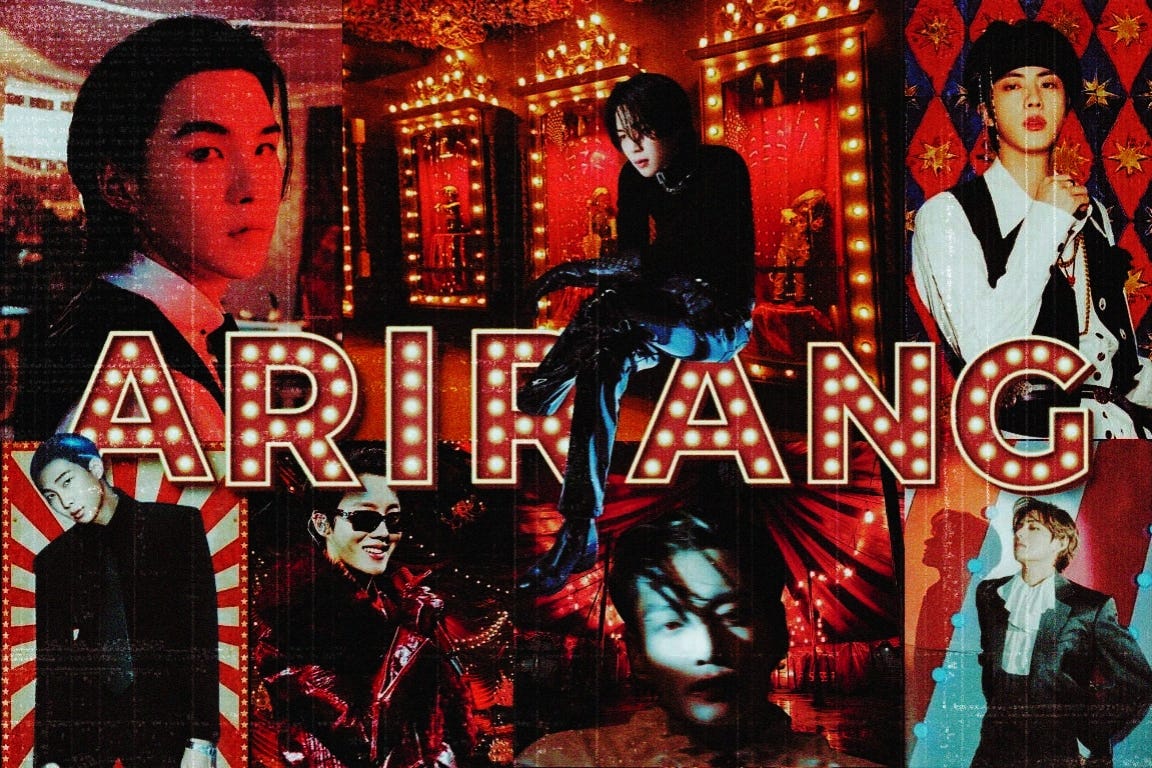
Also, ARIRANG gives me carnival vibes, hence the graphics. Just walk with me – I’ll explain it later in the post.
OVERVIEW
ARIRANG is a defiant post-enlistment comeback album that was released on March 20th, 2026, four years after BTS were forced to take a hiatus to fulfill their military duties. The release of this 14-track, 41-minute-long, identity-driven project comes after two months of songwriting and recording sessions with other collaborators – like Kevin Parker of Tame Impala, Mike WiLL Made-It, Artemas, Diplo, Flume, and many more – in LA during the summer of 2025.
Grounded in Korean cultural identity with strong heritage symbolism ingrained throughout – from the meaningful Arirang folk song sampled in the opening track to the clever lyrics that subtly point out the xenophobia Bangtan have faced and consistently reference various significant facets of Korean culture – This album simultaneously reaffirms BTS’s identity as proud Koreans who feel prideful of their roots while highlighting a split in identity at the same time.
The Korean cultural symbolism heard and felt throughout the album contrasts with the global-pop production, multiple Western collaborators, and fusion of Western rap, pop, house, and psychedelic influences. ARIRANG’s stylistically hybrid identity is also evident in the way the album is split into two parts, separated by the symbolic track No. 29.
While the first half of the album is full of harsher, rap-heavy, more performance-driven and club-centric tracks, the songs after No. 29 are melodic, reflective, atmospheric, and more pop-infused.
The result is an overall theatrical, ceremonial, layered, and immersive album experience – one that seems to be quite polarizing. Some critics and fans alike love it; others claim it feels like a rushed, disingenuous disappointment of an album. While some fans feel it brings back the essence of “old BTS,” others argue that the heavy use of Western collaborators, the “lack” of emotional depth, and a split in cohesion result in a feeling of a half-put-together album made with trend-chasing in mind instead.
My thoughts?
Well…
If You Miss “Old BTS” But Don’t Like ARIRANG…Why?
Before we get to the best part of this post (the track-by-track analysis), we’ve gotta talk about the “Old BTS” missers and why they aren’t satisfied with this album.
Personally, I don’t really follow critics too closely, so I can’t speak much on their takes, but as for the portion of the fandom who’ve, for years, been loud about “missing the old BTS and BTS’s old music,” I’m a bit confused about what’s not to like about this album, in that sense.
I can understand why the split structure might not work for everyone, even though I personally enjoy it – and although the argument that it doesn’t make any sense, especially for BTS, feels a bit odd, considering they’ve done similar things on previous albums, although to a lesser and not-so starkly contrasting extent.
And I can also see why others would argue that some of Bangtan’s earlier work felt more emotionally cohesive and lyrically compelling – because I’m not arguing that ARIRANG is their absolute best body of work thus far (they make excellent music, so what can I say? The competition is fierce.)
But the arguments that this album is completely shallow and lacks depth, that it isn’t lyrically compelling or emotionally meaningful at all, or that it “doesn’t even feel or sound” like BTS is very confusing to me as someone who’s listened to every one of their albums, in order of release, and each from top to bottom – on multiple occasions.
We’ll discuss the lyrics during the track-by-track analysis (because what do you mean this album is “lyrically weak?!”), but let’s talk about the similarities between ARIRANG and BTS’s older projects first.
The rap-heavy portion of the album took me straight back to the 2 Cool 4 Skool and Dark & Wild eras. Listening to the first half of ARIRANG had me grinning from ear to ear as I thought about how proud 2013 Bangtan would be if they could see 2026 Bangtan, who are just the cooler, richer versions of them.
Then there’s the fact that ARIRANG reflects the HYYH, Wings, and Love Yourself eras through its nuanced treatment of deep-seated issues.
Walk with me here: I, like many people, really enjoyed Dynamite, Butter, and Permission to Dance, but there were some people who disliked those eras since they were “too cookie-cutter,” “Too Westernized” (since they were all-English songs), and shared no deep, personal message.
Admittedly, this criticism irks me because when BTS released their album, BE – which I still think is one of their best albums to date – after Dynamite and a while before Butter and PTD, it didn’t get nearly as much of the love and recognition as it deserved from a lot of Army. Often, the same ones who complain about the “lack” of emotional content within the previously mentioned songs.
Be is easily one of BTS’s most introspective, raw, and authentic albums, with songs like Blue & Grey – which talks about depression and still hits hard to this day – and, of course, Dis-ease, plus Life Goes On, which cover burnout and perseverance.
It’s an album that covers difficult topics and contains emotional depth, through and through. It’s also an album that BTS very clearly poured their hearts and souls into during the height of the pandemic – which is what some people claim to be missing from ARIRANG. Heart and Soul.
And yet, BE – which seems to be the epitome of what some fans would like to see Bangtan “return to” these days – was paid dust when it was first released and is still paid dust to this day.
And ARIRANG, which consistently prioritizes showcasing the tannie’s Korean roots through culturally rich lyricism, traditional motifs woven into the production, prominent unofficial national anthem sampling, layered symbolism, and multiple references to their heritage – plus returns to the much-desired in-depth, emotionally-driven lyrical content (that some have been asking for them to return to for years, and which includes themes such as: loneliness, pressure, feeling like outsiders wherever they are, the paradox of fame, constant doubt, resilience, and more) … Is somehow apparently still too cookie-cutter, not deep enough, and does not resemble the “old” BTS who “talked about important issues more often,” and “had a different, better sound.”

My confusion remains prominent as I wonder what the difference in sound – between BTS’s older versus newer work – that people speak of actually is.
If anything, to me, this album sounds like BTS’s discography summed up in 13 tracks.
(Which, given how vast their discography is, can create problems in and of itself. And I can definitely see how that might not land with a lot of people, sure. But to say it doesn’t sound anything like them?)
Based purely on sonic similarity and/or vibes:
Body to Body belongs right beside ON, Idol, Intro: Persona, and Dionysus, if you ask me.
Hooligan fits right in with the Cyphers and the likes of Baepsae, interlude: shadow, and UGH.
(The dark, intense, and dystopian visuals in the MV look exactly like something early BTS would’ve done if they’d had more than five dollars and a dream to work with. And if I had to assign this song to a member, quite obviously, it would be Mr. Min Yoongi AKA Agust D. It fits right alongside his songs, Daechwita and Haegum.)
Aliens after Interlude: Shadow goes CRAZY. They are siblings.
FYA naturally joins the Burning Up (Fire), Outro: Ego, Mic Drop, and Not Today party.
Swim is literally Black Swan’s fraternal twin sister.
Merry Go Round feels directly related to Blue and Grey, Spring Day, and Jamais Vu #TOME!
Like Animals fits right in with Love Is Not Over, Fake Love, and (perhaps a reach, but it makes all the sense in the world to me) Save Me.
they don’t know ‘bout us has the same kind of vibe as 134340 and House of Cards – a sexy one. (Unless, of course, you actually know House of Card’s lyrics…But still.)
One More Night, Just Dance, Make It Right, Stay, and Telepathy sit at the same table. And this is the most Jungkook song ever.
Please is easily the most “old” BTS-coded song on the album, if you ask me. It very naturally meshes with Like, Coffee, Just One Day, Hold Me Tight, and more.
The list goes on and on.
Want to keep reading? You can find this post on Substack!

